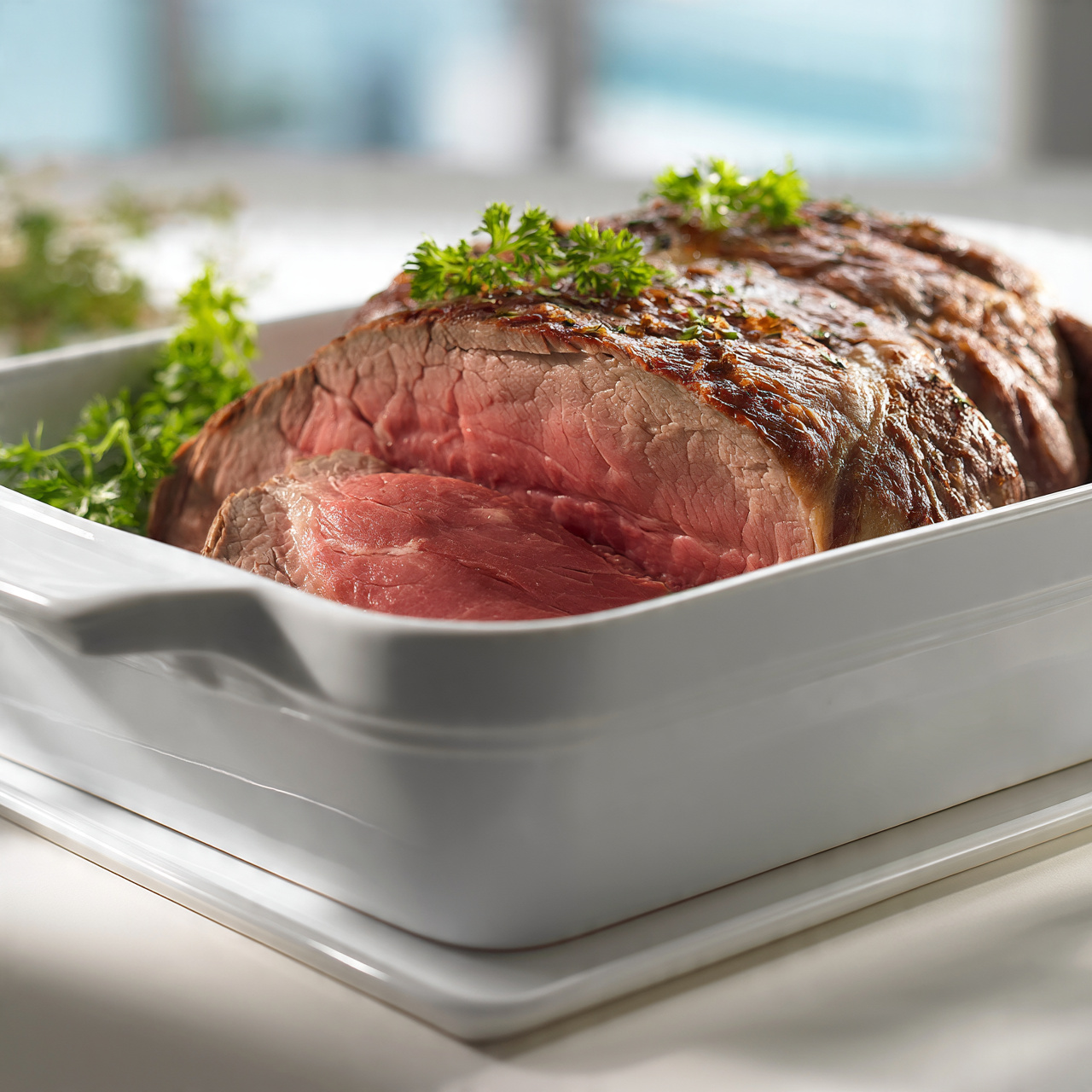
Perfect Roast Beef
Learn how to cook the perfect roast beef with a golden crust, juicy pink center, and deep savory flavor. This foolproof method delivers tender, restaurant-quality results every single time.

The Roast Beef You Will Make on Repeat
There is something deeply satisfying about a proper roast beef. The kind with a dark, herb-crusted exterior that crackles when you press it, giving way to a blush-pink, impossibly tender center. It is the centerpiece of a Sunday table, the star of a holiday spread, and honestly one of the most impressive things you can put in front of a crowd without spending all day in the kitchen.
This recipe is built around one core idea: simplicity executed with precision. You do not need a complicated marinade or a long list of exotic spices. What you need is great beef, a confident seasoning strategy, and a thermometer. That is it.
Choosing the Best Meat for Roast Beef
This is where everything starts. The best meat for roast beef is, without question, a ribeye roast (also called prime rib roast or standing rib roast). The fat marbled through the muscle bastes the meat from the inside as it cooks, producing a richness and juiciness that leaner cuts simply cannot match.
That said, not every occasion calls for a ribeye. Here is a quick guide to your options:
- Ribeye roast: Most flavorful, most forgiving, best for special occasions
- Sirloin roast: Leaner with a clean, beefy flavor. Great for everyday roasting
- Top round roast: Budget-friendly and lean. Best cooked to medium-rare and sliced thin
- Sirloin tip roast: A solid middle ground in both price and tenderness
Chef's Tip: Whatever cut you choose, always bring the meat to room temperature for at least one hour before it goes in the oven. A cold roast cooks unevenly, leaving you with an overdone exterior and an underdone center.
How to Season Beef for Roasting
The secret to deeply flavorful roast beef is layering your seasoning, not just sprinkling salt on the surface.
Here is the approach that works every time:
- Start with a thin smear of Dijon mustard all over the surface. It acts as a binder, adds a subtle tang, and gives the herb crust something to grip.
- Build a paste from softened butter, olive oil, minced garlic, fresh rosemary, thyme, smoked paprika, salt, and plenty of black pepper.
- Press that paste into every surface of the roast generously.
For the most impact, do this the night before and leave the roast uncovered in the refrigerator. The exposed surface dries slightly overnight, which means a better crust and a more concentrated flavor when it hits the oven.
Using quality ingredients here genuinely changes the outcome. Fresh herbs, good kosher salt, and real butter are not places to cut corners on a roast this size.
The High-Heat Sear and Slow Roast Method
This is the technique that separates a good roast beef from a perfect roast beef. The method is simple:
Start hot, finish slow.
You blast the roast at 450 degrees F for 15 minutes to build a deep, caramelized crust. Then you drop the heat to 325 degrees F and let the oven do its gentle work until the center reaches your target temperature.
Warning: Do not skip the resting period. A roast beef pulled straight from the oven and immediately sliced will lose a significant amount of juice onto the cutting board. Rest it tented under foil for at least 20 minutes and those juices redistribute back through the meat.
Internal Temperature Guide
The only truly reliable way to cook roast beef perfectly is with an instant-read meat thermometer. Here is what you are aiming for:
| Doneness | Pull Temperature | Rested Temperature |
|---|---|---|
| Rare | 120°F (49°C) | 125°F (52°C) |
| Medium-Rare | 130°F (54°C) | 135°F (57°C) |
| Medium | 140°F (60°C) | 145°F (63°C) |
| Well Done | 155°F (68°C) | 160°F (71°C) |
Always pull the roast 5 to 10 degrees before your target. It will continue to cook while it rests.
What to Have With Roast Beef
A roast this good deserves sides that can hold their own. Here are some pairings that work beautifully:
- Creamy mashed potatoes with plenty of butter and chives
- Roasted root vegetables tossed in the beef drippings from the pan
- Yorkshire pudding if you want to commit fully to a British Sunday roast
- Horseradish cream sauce for a sharp, cooling contrast to the rich meat
- A simple green salad with a sharp vinaigrette to cut through the fat
Do not let those pan drippings go to waste. Add a splash of beef broth, scrape up the fond, and you have an effortless jus to spoon over every slice.
Ready to make it? Here is the full step-by-step recipe:
Perfect Roast Beef
Learn how to cook the perfect roast beef with a golden crust, juicy pink center, and deep savory flavor. This foolproof method delivers tender, restaurant-quality results every single time.
Ingredients
- 3 lb beef ribeye or sirloin roast, tied with kitchen twine if needed, brought to room temperature
- 2 tbsp olive oil, extra virgin
- 6 garlic cloves, minced
- 2 tbsp fresh rosemary, finely chopped
- 1 tbsp fresh thyme, finely chopped
- 2 tsp kosher salt, or to taste
- 1 1/2 tsp coarse black pepper, freshly ground
- 1 tsp smoked paprika
- 1 tbsp Dijon mustard, spread over the surface
- 2 tbsp unsalted butter, softened
- 1 cup beef broth, for the roasting pan
- 1 yellow onion, halved, used as a roasting rack base
- 2 carrots, halved lengthwise, used as a roasting rack base
Instruction
Remove the beef roast from the refrigerator at least 1 hour before cooking to allow it to come fully to room temperature. This is the single most important step for even cooking.
Preheat your oven to 450 degrees F (230 degrees C).
Pat the beef completely dry with paper towels on all sides. Moisture is the enemy of a good crust.
In a small bowl, combine the softened butter, olive oil, minced garlic, rosemary, thyme, smoked paprika, salt, and pepper. Mix into a paste.
Spread a thin layer of Dijon mustard all over the surface of the roast. This acts as a binder and adds incredible depth of flavor.
Rub the herb and butter paste generously over every surface of the roast, pressing it into any crevices.
Scatter the halved onions and carrots across the bottom of a heavy roasting pan. These act as a natural rack and flavor the drippings. Pour the beef broth into the bottom of the pan.
Place the seasoned roast fat-side up directly on top of the vegetables.
Roast at 450 degrees F (230 degrees C) for 15 minutes to develop a deep, golden-brown crust.
Without opening the oven, reduce the temperature to 325 degrees F (165 degrees C). Continue roasting until the internal temperature reaches your desired doneness: 125 degrees F (52 degrees C) for rare, 135 degrees F (57 degrees C) for medium-rare, 145 degrees F (63 degrees C) for medium. This typically takes 60 to 75 minutes for a 3 lb roast.
Remove the roast from the oven and tent it loosely with aluminum foil. Rest for at least 20 minutes before slicing. The internal temperature will rise by 5 to 10 degrees during resting.
Slice against the grain into thin, even slices and serve immediately with the pan drippings spooned over the top.
Equipment
- Heavy roasting pan or cast iron skillet
- Instant-read meat thermometer
- Aluminum foil
- Sharp carving knife
- Cutting board
- Small mixing bowl
- Paper towels
Notes
Storing and Reheating Leftover Roast Beef
Leftover roast beef is genuinely one of life's great pleasures. Thin-sliced cold roast beef on a crusty roll with horseradish and arugula might actually be better than the original dinner.
To store it well, place slices in an airtight container and pour a spoonful or two of the pan drippings over the top. This keeps the meat moist in the fridge for up to 4 days.
To reheat without drying it out, skip the microwave. Instead, warm slices gently in a covered skillet with a splash of beef broth over low heat for 3 to 5 minutes. It comes back beautifully.
For longer storage, roast beef freezes well for up to 3 months. Wrap individual portions tightly in plastic wrap, then place in a freezer bag. Thaw overnight in the refrigerator before reheating.